Insights · MRV
What is MRV in a reforestation project? Understanding forest carbon monitoring, reporting and verification
The success of a reforestation project is not measured only by the number of trees planted. It also depends on the ability to track their growth, assess environmental change and demonstrate results over time.
In carbon projects, this need for transparency relies on a framework known as MRV: Measurement, Reporting and Verification.
MRV is essential to improve the traceability of forestry projects, document their climate contribution and build the confidence of investors, partners and other stakeholders.
But how does MRV actually work in a reforestation project?
1. What does MRV mean in forestry?
MRV refers to a set of procedures used to collect, organise, analyse and verify information about the results of a climate action.
It rests on three complementary components.
Measurement
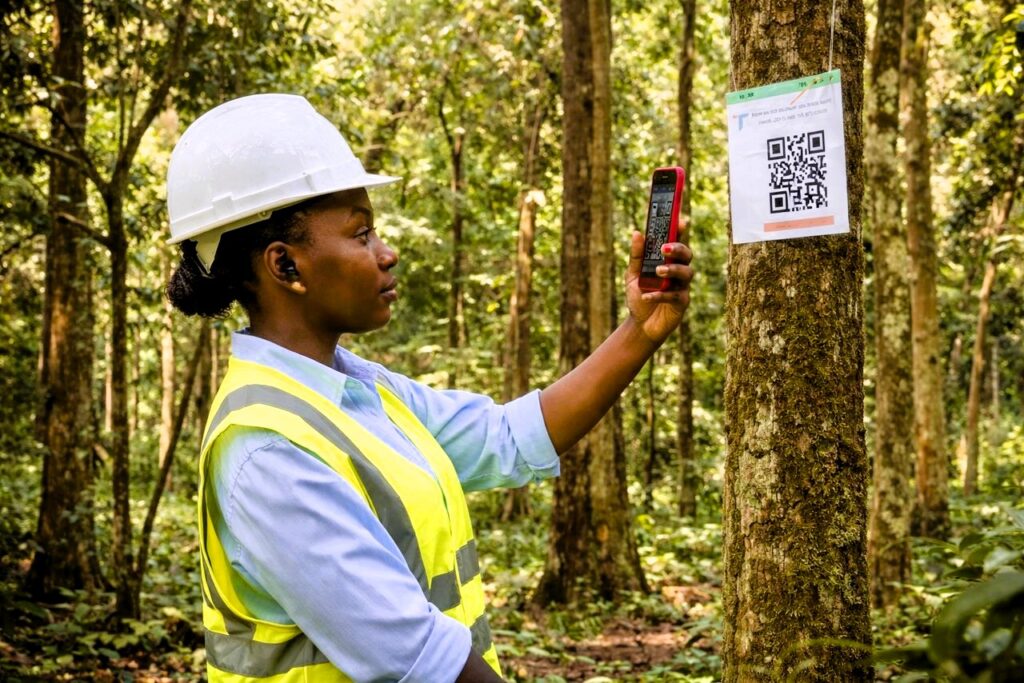
Measurement means collecting the data needed to assess how the project is progressing.
In a reforestation project, this can include:
- The area of restored plots.
- The number of trees planted and their survival rate.
- The species used.
- Tree growth and development.
- Changes in vegetation cover.
- Estimates of biomass and carbon stocks.
This information comes from field observations, forest inventories and, where needed, geospatial and satellite data.
Reporting
Reporting means organising the collected data and presenting it in a structured, understandable form.
It documents the activities carried out, the results observed, the calculation methods used and any limitations of the data.
A monitoring report may present, for example, how plots have evolved, maintenance operations, field observations and carbon stock estimates.
Verification
Verification examines whether the information reported is reliable and complies with the requirements that apply to the project.
Depending on the framework, it may involve an independent body that assesses the data, methods and supporting evidence.
Verification therefore strengthens the credibility of the results presented.
2. Why is MRV essential in a reforestation project?
A forestry project develops over several years. Between initial planting and the expected results, many factors can influence its progress: weather conditions, water availability, land pressure, disease, fire or human activity.
Without regular monitoring, it becomes difficult to know the exact state of the project.
MRV makes it possible to:
- 01
Track project performance
Data shows how plantations are growing and highlights areas that need intervention.
- 02
Assess climate results
Biomass and carbon stock data can feed into the appropriate quantification methods to estimate CO₂ removals.
- 03
Strengthen transparency
Documented information makes activities easier to check and results easier to communicate to partners.
- 04
Support investment decisions
Reliable, regularly updated data helps investors better understand a project’s performance, risks and stage of development.
3. How does an MRV system work?
A forest MRV system can be organised around several steps.
- 01
Step 1: Establish a baseline
Before activities begin, the initial characteristics of the project area must be documented: land use, existing vegetation, geographic boundaries and other relevant parameters.
- 02
Step 2: Collect data
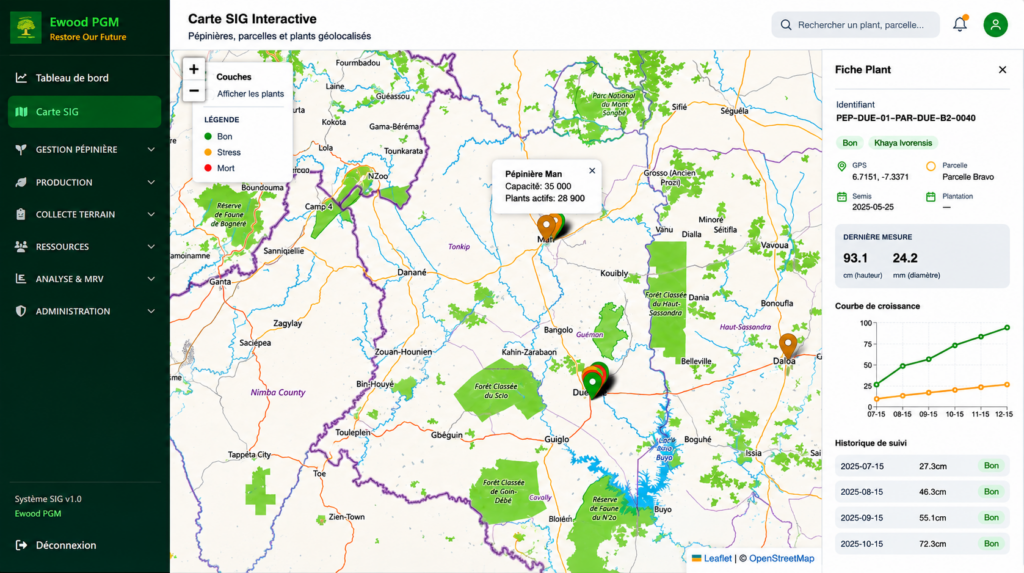
Field teams carry out the necessary observations and measurements. Data can be supplemented by satellite imagery, GPS surveys and digital tools.
- 03
Step 3: Centralise and analyse information
The information collected is organised in a system that allows it to be consulted, compared and analysed over time.
- 04
Step 4: Produce monitoring reports
Results are documented according to the requirements of the project and the applicable methodology.
- 05
Step 5: Verification
Data and supporting evidence can then go through an independent verification process where the project framework requires it.
4. The role of technology in forest MRV
Digital technologies help improve how data is collected and used.
Satellite imagery makes it possible to observe changes in vegetation cover over large areas. Drones can provide more detailed observations at plot level. Geographic information systems help visualise project boundaries and cross-reference spatial information.
Digital monitoring applications make it easier to centralise, organise and use field data.
However, technology does not replace forest observations. A reliable MRV system depends on combining physical measurements, geospatial data and control procedures.
Read more about EWOOD PGM’s technology and MRV approach.
5. MRV and carbon projects: a question of credibility
In the carbon market, data quality is decisive.
A project cannot claim credible climate results on the basis of the number of trees planted alone. Under the applicable methodological framework, it must show how removals are quantified, how uncertainty is accounted for and how results are monitored.
MRV therefore helps build trust between project developers, investors, carbon credit buyers and verification bodies.
6. The EWOOD PGM approach: combining forestry expertise and technology-based monitoring
Developing sustainable forestry projects requires a combination of operational expertise, knowledge of the territories and suitable monitoring tools.
EWOOD PGM builds its approach on this combination of forestry activities, carbon project development and technology solutions for monitoring, measurement and verification.
The aim is to improve the traceability of operations, manage information in a structured way and document project results.
Learn more about the Tiapleu reforestation project in Côte d’Ivoire.
Conclusion
MRV is much more than a reporting tool. It is a fundamental system for documenting environmental performance, strengthening transparency and supporting the development of credible carbon projects.
As transparency requirements grow in the carbon market, the ability to produce reliable, verifiable data is becoming a real differentiator.
Are you developing a reforestation or forest carbon project?
Let’s discuss monitoring, measurement and verification solutions suited to your needs.
