Ecological Restoration
Transforming degraded land into functioning forest ecosystems, one native species at a time. 6,000 hectares. 40 years of monitoring. Net carbon positive from year one.
Restoration approach
Degraded land assessment
Every parcel entering the reforestation zone undergoes a multi-parameter baseline assessment, soil carbon, pH, compaction, hydrology and prior land use. This data defines the planting model and sets the additionality baseline against which all sequestration is verified.
Phased planting
Restoration follows a phased programme: pioneer species first to stabilise the soil and provide shade, then sub-canopy natives, then long-rotation emergents. Each phase is sequenced to the previous one's canopy closure, typically 18–24 months between phases.
Long-term monitoring
Permanent sample plots across all terrain types are measured quarterly. Satellite imagery, drone surveys and ground-truth field data are integrated into EWOOD's MRV platform, providing continuous ecosystem health indicators from baseline through to full canopy closure.
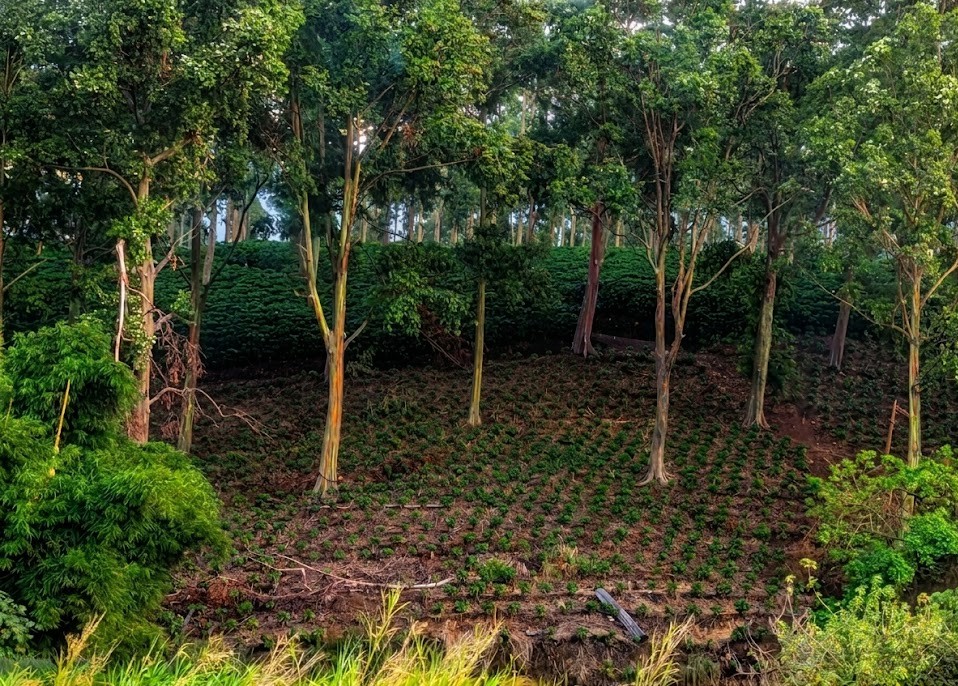
From degraded field to closed-canopy agroforest
The Tiapleu landscape was characterised cocoa plantations, fragmented agricultural areas, and degraded forests, before EWOOD PGM's restoration programme began. Within just four years, pioneer species established a continuous understory across the initial restoration sites, while emerging hardwood trees have begun to form an upper canopy, gradually restoring the structure and ecological functions of the forest
- Bare laterite soils progressively covered by pioneer canopy
- Soil organic matter increasing measurably across all sampled plots
- Watercourse vegetation recovering, dry-season flow observed
- Bird species richness 3× baseline in oldest planted zones
Restoration milestones
Full landscape baseline survey, soil carbon, land cover, biodiversity and socioeconomic data collected across 6,000 ha. Verra additionality baseline locked.
1,000,000 seedlings/year capacity nursery operational, proprietary hardening protocols achieving ≥85% field survival across 15+ native species.
Large-scale planting campaigns across all terrain zones. Pioneer canopy establishing across early-planted parcels. First allometric growth measurements recorded.
Full MRV platform active. First VCU issuance cycle under VM0047 underway. Digital field data integration with satellite monitoring operational.